(Reading, writing, editing, publishing, browsing, borrowing, telling you about it.)
Showing posts with label visited. Show all posts

Sunday, April 10, 2011

Skulking in San Francisco


I spent last week in California, mainly in San Francisco, where there is some very good book shopping to be had. Here's what I came back with:

From Aardvark Books (used) near the corner of Church and Market Street:
Selected Poems by Robinson Jeffers. Just a little Vintage paperback, but Jeffers, a California poet, has been on my to-read list for a couple of years now, so I decided to pounce in case I didn't happen to see any other editions of his work during the visit. A few days later when we travelled south, I was able to read the poem "Morro Bay" in downtown Morro Bay while in view of the town's legendary rock. Yes, this is the sort of dorky tourism I go in for.
An Oregon Message by William Stafford. The first poem is about writing in a journal and the last about riding a bicycle. Sold.

From Booksmith on Haight:
Sorry, Tree by Eileen Myles. A California poet, and an enticing cover design from Wave Books.
Praise by Robert Hass, who I suppose needs no introduction though I have read very little of his poetry.
In Search of Small Gods by Jim Harrison, of Legends of the Fall fame and a fellow Arizona enthusiast. (Also poetry.)

From William Stout Architectural Books on Montgomery Street:
An Essay on Typography by Eric Gill
Anatomy of a Typeface by Alexander Lawson
The Business of Books by André Schiffrin

William Stout is well worth a visit if you have any architectural, interior design, visual art interests. They have a small typography section downstairs and I spent most of my time there. The Eric Gill essay is, I understand, sort of a classic, and since Gill's Joanna is one of my favourite fonts and one of the small handful I can pick out in a lineup, he is big in my would-be-expert world. The Lawson book is an in-depth look at the history and composition of thirty typefaces. Perhaps my repertoire of ones I can identify will have grown a bit by the time I've finished reading it. The Schiffrin I had heard nothing about previously, but the subtitle, "How International Conglomerates Took Over Publishing and Changed the Way We Read," suggests a topic that looms fairly large in my life, so I couldn't not get it.

The trip wasn't all books, though. My sister and I also visited the Heath Ceramics shop at the Ferry Building for made-in-California dishware and glass jars, which then had to be carefully transported around the state, then through three airports, and finally home.

Tuesday, February 22, 2011

PrairyErth


William Least Heat-Moon
Houghton Mifflin (1991)

I bought this on one of my last visits to The Odd Book in Wolfville, N.S., before moving to Halifax almost a year ago. The Odd Book is relatively small, but it's well organized and specific without being snobbish. There are dedicated Classics, archaeology and linguistics sections, for example, but also a wall of mass-market mysteries and a good stash of Archie comics. A friend of mine once said, before coming home for a summer while doing his Master's degree, that the only place in the Valley he wanted to work was The Odd Book and that if he couldn't work there he wasn't really sure what he was going to do. They weren't hiring. I'll have to check and see if he's over that yet.

On this visit I came to the cash with William Least Heat-Moon’s first book, Blue Highways, in my hand, and the store’s owner, Jim Tillotson, steered me toward PrairyErth on the new arrivals shelf. I read the first couple of chapters soon after, but was just too buried in the minutiae of moving into a new place and learning how to be a working person again – lunch-packing, for instance, eluded me for the first few weeks – and so I put the book aside. Then, after finishing The Great Railway Bazaar back before Christmas I found myself still in the mood for non-fiction but wanting something a bit more…stationary, and PrairyErth beamed from the shelf, looking fat and happy and entirely unscathed from its previous rejection.

The book is subtitled (a deep map) and that's exactly what it is. Heat-Moon went to Chase County, Kansas, a place where not much is thought to happen, and just inched his way through it, sometimes walking, sometimes rooting in courthouse records and the journals of those who settled or passed through, and sometimes waiting, in the grass or in a bar or in his van, to see what does happen. Some of his research has to do with particular routes through the county – railroads, secondary highways and paths. In one of my favourite sections he tries to uncover the Orient Line, a railway that was to have connected Kansas City and China, via Mexico, but that he begins to suspect may be no more than rumour.

Kansas is more or less the dead middle of the (contiguous) United States, and it's also where east becomes west, or vice versa. It's got the last large expanse of tallgrass prairie in the country, and one of the recurring elements in PrairyErth is the position of various people Heat-Moon interviews on the proposed Tallgrass Prairie National Preserve (which was successfully established a few years after the book's publication). It's a contentious issue for Kansans who still dream of a return to the days when a viable living could be made working prairie rangeland. In one chapter Heat-Moon recounts a conversation he has with essayist Wes Jackson in which Jackson outlines his vision for a new kind of agricultural community for a post-oil future, a model suited to the current economic reality in Chase County: relying and putting a greater value on human labour and keeping more of the products of that labour in the local area.

PrairyErth is of a piece with some of John McPhee's writing, in terms of the steady, on-the-ground chipping away at history, geology, ecology, economics, and ... I don't know, maybe happenstance, and the implied conviction that these need to be studied together. My one disappointment with it was that the parts I expected to like the most I actually liked least. These are where the author examines the effect of the prairie on his mindset. I travelled across Montana and North Dakota by train a couple of years ago and I guess had secretly hoped to find a closer articulation of my own experience of that landscape. The sentiments seem quite genuine, but the language he used often left me cold. Walking kept wandering into dreaming and into baggy statements about time. Given how much I like the rest of the book I'm tempted to say this is really a matter of vocabulary. Or a cultural divide, and I am just being ignorant.

Or maybe it's all the solitude. In the final chapter Heat-Moon and a friend, a fellow writer the (now) late Clive Scott Chisholm, embark on a multi-day walk to try to find the Kaw Trail, a path through the county, once travelled by the Wind People tribe when they were relegated to territory south of their original lands. Together the pair bounce ideas about the prairie off each other that to me are much more accurate and interesting than much of Heat-Moon's deeper solo musings. With Chisholm Heat-Moon has a sympathetic ear (Chisholm himself wrote a book about a long walk he did following the Mormon route from the Missouri River to the Great Salt Lake Valley) and someone to jog him out of the most earnest of his ruminations. There is a Tent Dwellers-like repartee here, both in terms of the wit and a particular brand of checked intuition. It was a good note to go out on, I thought.

Sunday, October 31, 2010

October's reads and buys

Oh, hi. Oh, hell, more like it. I went home, I came back, things got a bit busy. Here's a little update on some of my readings & buyings since my last dispatch:

The Adventures of Sherlock Holmes by Arthur Conan Doyle
I was about a hundred pages from the end of Jonathan Franzen's new novel, Freedom (which has been reviewed pretty exhaustively all over the place, so I won't get into it here), when I left for Vancouver and couldn't quite rationalize lugging it along. So I left it in Halifax and bought a very beat-up copy of The Adventures..., which includes the first twelve Holmes stories, from the airport bookstore during my stopover in Toronto. Although I'm sure I appear anything but, I always feel oddly streamlined when I travel alone, and mysteries with aloof, intrepid sleuths seem to fit my mood while skulking around airports. Although the tight turnaround of each case is pretty satisfying, I'm keen now to check out Holmes in novel length.

Stranger Wycott's Place by John Schreiber
I found this in one of my dad's little piles of papers during my visit home. It was published a couple of years ago in New Star Books' Transmontanus series, which consists mainly of short, oddball books on various aspects of BC history and culture. This one is in the Don McKay vein of creative non-fiction, combining archival research with long tromps around the grasslands in the Cariboo region, a little north of where my parents live. There are some frustrating lapses into bland, non-specific niceties about place and connectedness that seemed more borrowed than really lived, but when he's out walking or immersed in the trail of patchy family records, piecing together Wycott's story, Schreiber's writing is quite sharp. He's also provided a good basic Cariboo reading list at the back, which I plan to revisit soonish.

Lost River by James Tate
The September issue of Poetry included an essay by Tony Hoagland recommending Tate as a poet "trafficking in disorientation" but with a strong narrative bent, and so he was on my list when I went to Powell's in Portland, Oregon. Well, actually, first I told myself I wouldn't start in the poetry section because that was where I got stuck for most of my first visit there last summer. Three hours later I realized I done the very same thing. Lost River is a Quarternote chapbook from Sarabande Books in Louisville, Kentucky. I like chapbooks and there aren't that many publishers doing them, so I picked this over the full-length collections nearby. Tate's sensibilities had me from the start. Here are the first few lines from a poem called "Making the Best of the Holidays":

Justine called on Christmas day to say she
was thinking of killing herself. I said, "We're
in the middle of opening presents, Justine...


Before I left Powell's I did squeeze in a quick jog through the North American history section, where I found a very cool letterpress book that will have its own post sometime soon(er than later).

Thursday, July 29, 2010

From the Bookery


The trip to St. John's, NL, this past weekend was most excellent. It was drizzly the first day, but that was a welcome change in the midst of the heatwave persisting back in Halifax. My previous visit to Newfoundland was toward the end of a summer-long bike tour in 2001 and a much less relaxed affair. This time there were long walks, picnics, beer, meals out, and an afternoon at the provincial art gallery, The Rooms. On Friday afternoon I found a great little bookstore called The Bookery a few minutes' walk from downtown up Signal Hill Road. The selection was surprising for a store of its size, with better representation from small presses than I've seen in a long while. I made a few passes through before settling in the poetry section by the stairs. My eventual picks were Gander poet Stephen Rowe's debut collection Never More There, published by Nightwood Editions last year; more established Newfoundland poet Mary Dalton's fourth collection, Red Ledger, published a few years ago by Signal Editions; and Karen Solie's Pigeon, this year's Griffin Prize winner, published by Anansi. After that I tromped back down the hill for a pint of stout at the Yellow Belly microbrewery on Water Street. It was all too much really.

I will post more on all of these new purchases very soon. The Count-down is on. I have run out of enthusiastic musings on the 1095-page beast and now just have my eye on the finish line.

Monday, May 17, 2010

Raymond Chandler, local haunts


Over the past few months at my newish day job I've been editing a mystery novel. This particular manuscript isn't a strict member of the genre, but it spurred my interest. With the exception of a few John Le Carrés in recent years and a couple of Mrs. Pollifax mysteries when I was nine or ten (which I know, I know, are also both departures from the main), it remains an unread corner of the library I suspect might be a real gold mine. The Pollifaxes were actually located in the large-print section of our library, which I originally mistook as being the obvious segue from Y.A. to adult fiction.

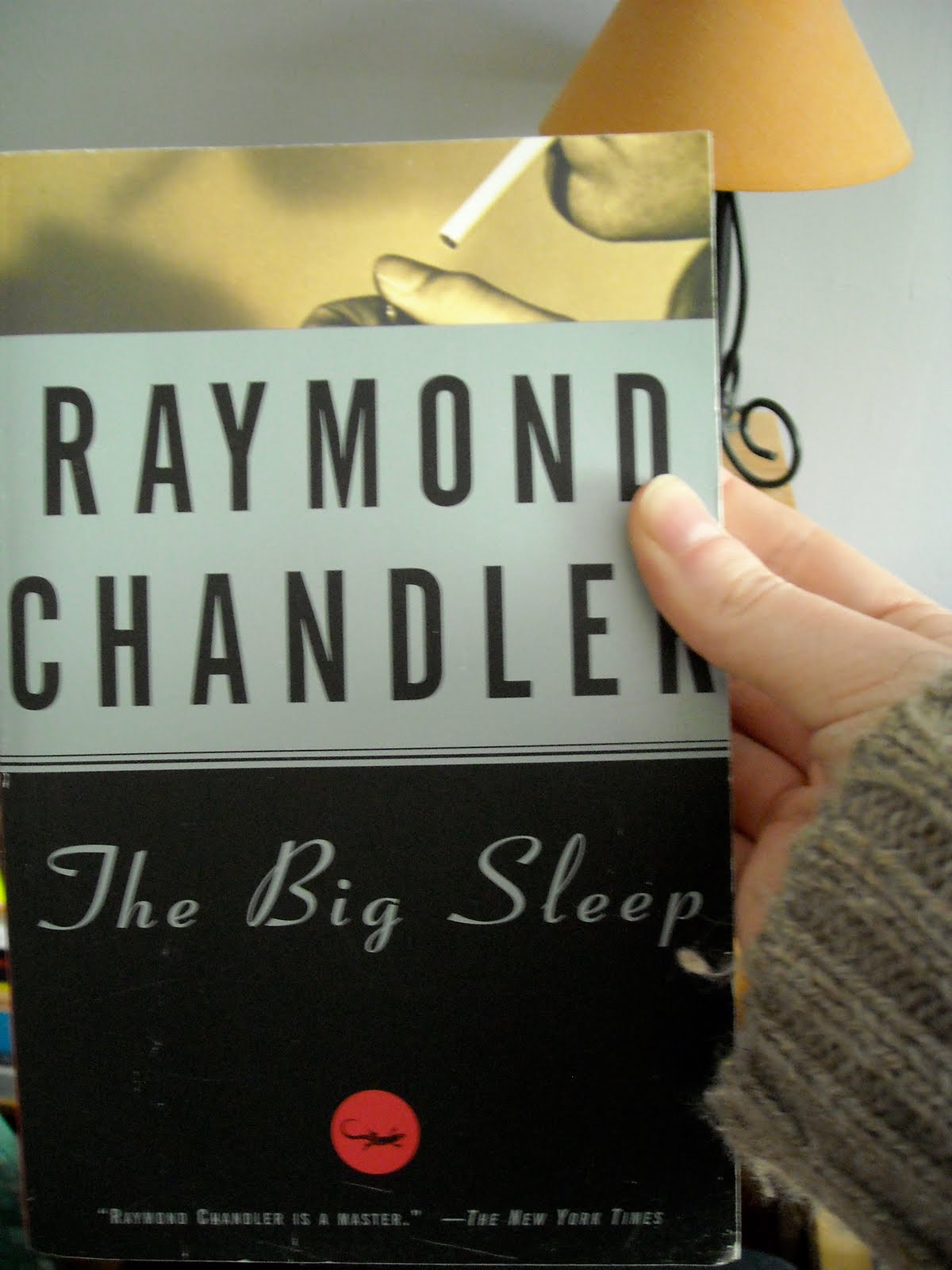
Last weekend I spent a happy hour or so perusing in a secondhand bookstore I'd been meaning to visit in my neighbourhood. A little jazz was playing on the stereo inside the store, and there was a pair of older gentlemen in armchairs in the middle of the store discussing bicycles. Can I reserve my spot now? The back corner was dedicated to detective/mystery/crime/espionage and I found a recent edition of the first of Raymond Chandler's Philip Marlowe novels, The Big Sleep. I was going to attempt a definition of Chandler's place in the world of detective literature, but coming from me it would only be a paraphrasing of various Wikipedia entries, so I'll leave you to consult amongst yourselves. He just about had me at hello, though. Here's a sample from page 1:

The main hallway of the Sternwood place was two stories high. Over the entrance doors, which would have let in a troop of Indian elephants, there was a broad stained-glass panel showing a knight in dark armor rescuing a lady who was tied to a tree and didn't have any clothes on but some very long and convenient hair. The knight had pushed the vizor of his helmet back to be sociable, and he was fiddling with the knots on the ropes that tied the lady to the tree and not getting anywhere. I stood there and thought that if I lived in the house, I would sooner or later have to climb up there and help him. He didn't seem to be really trying.


I was cackling and the older gentlemen were now staring at me, so I decided to shove off. They approved of my purchase and pointed out that there were lots of lady mystery writers too. I look forward to it.

I want to get back to this business of genres sometime, though. I take real issue with the whole notion. If we can label a well-crafted piece of fiction that happens to centre on, say, a murder/disappearance/heist (aliens/androids/mermen), then can we please also declare the angst-ridden Canadian family saga its own genre rather than simply calling it Literary? Certainly there is less ambitious work being written to a bungled understanding of the example set by the best in this vein. I feel an unwieldy rant coming on that I want to save for another time. Besides, I have to price an order of What Would Marlowe Do? bracelets. Takers?

Tuesday, May 11, 2010

Singing Wind Bookshop, Benson, AZ


This past November my partner kindly donated some of his hard-won aeroplan points to me so that I could travel with him to a conference he was attending in Phoenix and celebrate my thirtieth birthday in the desert. Mostly I celebrated in airports and on airplanes, but by sunset I was parked on the patio of our hotel room, shoes off, beer in hand, and a couple of monster cacti within reach.

On the last day of our trip, we drove an hour or so east of Tucson to the town of Benson, and then down a long dirt road, over a cattle guard, and past a fierce Dalmatian to visit Singing Wind Bookshop, "Headquarters for Books about the Southwest." The shop had been recommended by a family friend, and I doubt we would have found it otherwise.

I have several favourite bookstores, some dead, some still living: J. W. Doull here in Halifax, Duthies in Vancouver, Pages in Toronto, Elliott Bay Books in Seattle, and the monument that is Powell's in Portland, Oregon. Singing Wind is of a different ilk, but may be my new number one. And it might well be the only bookstore situated in the middle of a cattle ranch. Its owner, Winifred Bundy, welcomed us with a tour of the store that I wish I could quote more of here. I do remember that it included mention of short and tall Californians--referring to the height of the books, not the authors (cue pause for acknowledgement of the joke--we were happy to provide).

Bundy doesn't have an online store, and she only accepts cash or cheque. We were the only customers in the store, but there was a sense that things were thriving. We were invited to a fiesta in celebration of a local author, taking place the following afternoon (refreshments and valet parking provided). There are a handful of times in my life when I've seriously considered skipping a return flight, and this is one of them. I wanted to buy the closest property for sale and spend the next ten years reading whatever Bundy told me to. Or working my way through the store shelves, which I think would amount to more or less the same thing.

What did we buy? I'll preface this short list by reminding you of the cash-only situation. Many a volume was carted around the store and then reluctantly returned to its shelf. However: Desert Solitaire by Edward Abbey, Islands of Books by Lawrence Clark Powell (for a good, though now slightly dated, introduction to Southwest literature, check out his Books: South Southwest) and a trio of lectures given by Powell, recorded by members of the band Calexico, and released by Singing Wind itself. Dear reader, three words: Benson. Go. Now.